PM Narendra Modi Chairs High-Level Meeting With Government Secretaries, Calls for Long-Term Vision and Better Use of Data and AI
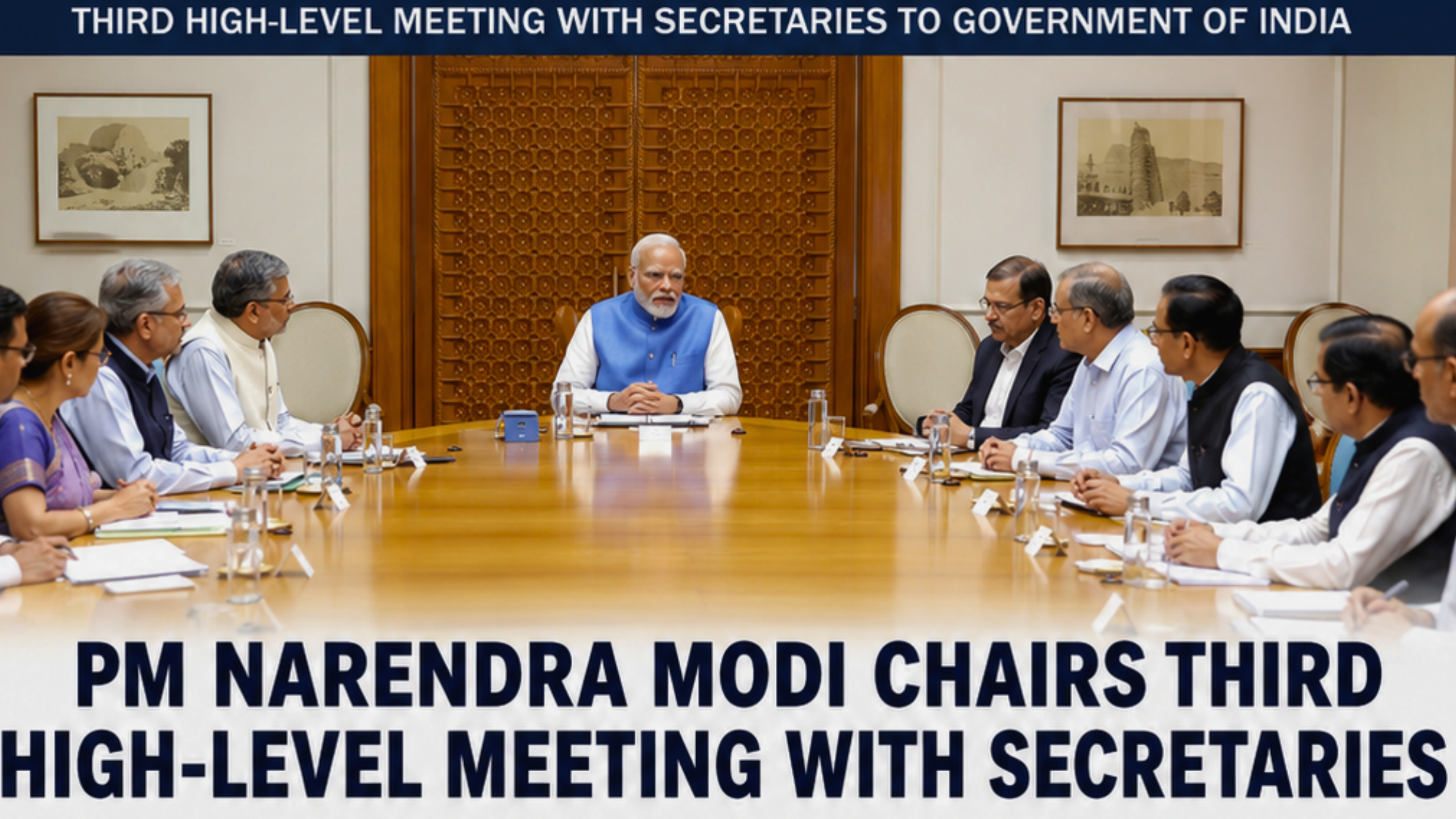
New Delhi: Prime Minister Narendra Modi chaired the third High-Level Meeting with Secretaries to the Government of India, focusing on long-term national priorities, effective governance, technology, data, artificial intelligence, defence manufacturing and stronger coordination between government departments.
During the meeting, Prime Minister Modi urged senior government officials to think beyond immediate administrative priorities and consider how India’s future should be shaped over the long term. He emphasized the importance of developing a clear vision for the country and ensuring that government policies and implementation efforts remain aligned with broader national objectives.
A major focus of the meeting was the role of data in governance and national development. Prime Minister Modi described data as a national asset and an important resource for the future. He called for greater interoperability between government systems and encouraged departments to make more effective use of available data.
According to the Prime Minister, better use of data can help governments understand problems more effectively, improve decision-making and design policies based on evidence. Greater coordination between departments can also reduce duplication and help public institutions deliver services more efficiently.
The Prime Minister also spoke about the problem of working in organisational silos. He said that silos are not simply an organisational issue but can also reflect a mindset. He urged officials to move beyond departmental boundaries and work with a spirit of belongingness toward the larger national interest.
Greater cooperation between departments can be particularly important when dealing with complex issues that involve multiple areas of government. Problems related to infrastructure, employment, technology, education, healthcare and national security often require coordination across several departments rather than isolated action.
Prime Minister Modi also highlighted the importance of informal interaction among senior officials. He emphasized that building stronger personal connections and team spirit can improve coordination and cooperation within the government.
According to the Prime Minister, informal interaction can provide officials with opportunities to exchange ideas more freely, understand challenges faced by other departments and develop a stronger sense of teamwork. Such interactions can complement formal administrative processes and contribute to more effective implementation.
Another important issue discussed during the meeting was the need for greater engagement between government departments, universities and young people. Prime Minister Modi called for policymakers to interact more closely with academic institutions and younger generations in order to bring fresh perspectives into policymaking.
Universities and research institutions can provide expertise, data and new ideas that may help government departments understand emerging challenges. Young people can also bring different perspectives on technology, employment, education, entrepreneurship and social change.
The Prime Minister's emphasis on connecting government with universities and young people comes at a time when technology and economic changes are rapidly transforming the way societies work. Greater interaction between policymakers, researchers and younger citizens could help government institutions better understand emerging trends and develop policies suited to future requirements.
Artificial intelligence was another major area of discussion during the meeting. Prime Minister Modi called for the effective use of AI while stressing the importance of maintaining human intervention and judgment.
AI has the potential to assist government departments in areas such as data analysis, public service delivery, administrative processes and decision-making support. However, the Prime Minister emphasized that technology should not completely replace human judgment.
Human oversight remains important when government decisions involve complex social, economic, ethical or security considerations. The responsible use of AI therefore requires a balance between technological capabilities and human responsibility.
The meeting also addressed India's defence industry and the need to strengthen its competitiveness at the global level. Prime Minister Modi emphasized the importance of further developing India's defence manufacturing capabilities and making the country's defence industry more competitive internationally.
Strengthening domestic defence production can support national security while also creating opportunities for manufacturing, research, innovation and exports. A more competitive defence industry can help India develop advanced technologies and reduce dependence on foreign sources for critical equipment.
The discussion comes as India continues to focus on increasing domestic manufacturing and developing capabilities in areas involving advanced technology. Greater collaboration between government institutions, industry, research organisations and universities could play an important role in developing a stronger defence ecosystem.
During the meeting, Secretaries to the Government of India shared their perspectives on key national priorities and discussed challenges associated with implementation. Their inputs provided an opportunity to examine how government policies can be translated into effective action at the ground level.
Implementation is often one of the biggest challenges in public policy. A policy may have clear objectives, but achieving those objectives can require coordination among multiple departments, sufficient resources, reliable data and effective monitoring.
The meeting therefore focused not only on policy priorities but also on the practical challenges faced during implementation. Inputs from senior officials can help identify administrative obstacles and explore ways to improve coordination and delivery.
The Prime Minister's emphasis on long-term thinking also highlights the importance of preparing for challenges that may not immediately affect the country but could become significant in the future. Technological change, demographic shifts, global economic competition, climate-related risks and national security developments require governments to plan beyond short-term cycles.
Long-term policymaking can help ensure that investments made today support India's future economic and social development. It can also encourage government departments to look at policies from a broader national perspective rather than focusing only on immediate departmental objectives.
Data is expected to play an increasingly important role in this process. Government departments generate and hold large amounts of information related to citizens, infrastructure, economic activity and public services. When appropriately managed and used with necessary safeguards, interoperable data systems can help departments identify trends and make more informed decisions.
At the same time, effective data use requires attention to privacy, security, accuracy and responsible governance. Simply collecting large amounts of information does not automatically lead to better policy. Data must be reliable, appropriately shared and converted into useful insights.
The discussion around AI similarly reflects the growing importance of emerging technologies in governance. AI tools can process large datasets and assist officials with complex analytical tasks, but their use needs appropriate human oversight.
The meeting's focus on breaking silos also reflects the interconnected nature of modern governance. A major national challenge rarely fits neatly within the responsibilities of a single department. Effective solutions may require officials from different ministries and institutions to share information, coordinate their activities and work toward common objectives.
Building a stronger team spirit among senior officials can therefore support better coordination. Informal interaction, shared objectives and a sense of collective responsibility can help create an environment where departments are more willing to cooperate.
The emphasis on young people and universities adds another dimension to the policymaking process. Academic researchers can contribute specialized knowledge, while young people can provide perspectives based on changing social and technological realities.
Closer engagement with these groups can help government institutions identify emerging opportunities and challenges at an earlier stage. It can also encourage innovation and make policymaking more responsive to changing circumstances.
The meeting brought together senior government officials to discuss these issues and implementation challenges. The Prime Minister's directions covered several areas, including long-term planning, data governance, interdepartmental coordination, teamwork, youth engagement, artificial intelligence and defence industry development.
Taken together, the priorities discussed at the meeting point toward a governance approach focused on long-term planning, technology-enabled decision-making and stronger institutional cooperation.
For India, the ability to convert these priorities into measurable results will depend on implementation. Coordination between departments, effective use of data, responsible adoption of AI, engagement with academic institutions and industry, and continued attention to national security could all contribute to achieving the broader goals discussed during the meeting.
What meeting did Prime Minister Narendra Modi chair?
Prime Minister Narendra Modi chaired the third High-Level Meeting with Secretaries to the Government of India, where senior officials discussed key national priorities and implementation challenges.
What did PM Modi say about data?
The Prime Minister described data as a national asset and a resource for the future. He called for greater interoperability and more effective use of data by government departments.
What did PM Modi say about government silos?
He said that silos are not merely an organisational problem but can also be a problem of mindset. He encouraged officials to work beyond departmental boundaries with a spirit of belongingness.
What was discussed about artificial intelligence?
Prime Minister Modi called for effective use of AI while emphasizing that human intervention and judgment should remain important in the process.
Why did PM Modi emphasize universities and young people?
He called for greater engagement between government departments, universities and young people so that fresh ideas and perspectives can contribute to policymaking.
What did PM Modi say about India's defence industry?
He emphasized the need to further strengthen India's defence industry and make it more competitive at the global level.
Prime Minister Narendra Modi's third High-Level Meeting with Government Secretaries focused on several areas that could shape India's governance and development priorities in the coming years. Long-term thinking, effective use of data, stronger cooperation between departments, responsible adoption of AI, engagement with universities and young people, and a more competitive defence industry were among the key themes.
The meeting also placed emphasis on implementation and the need for officials to work collectively rather than within isolated departmental structures. The Secretaries shared their perspectives on national priorities and the challenges involved in implementing government initiatives.
The discussions underline the importance of combining technology, institutional cooperation and long-term planning to address India's future challenges. The effectiveness of these priorities will ultimately depend on how successfully they are translated into policies, programmes and measurable outcomes across the country.
Get FlashNews24 App
Get breaking news, India news, World news, technology updates and more directly on your phone.
📱 GET THE APP