Solar Storm Explained: How Sun Eruptions Can Affect Earth, GPS, Satellites and Power Grids
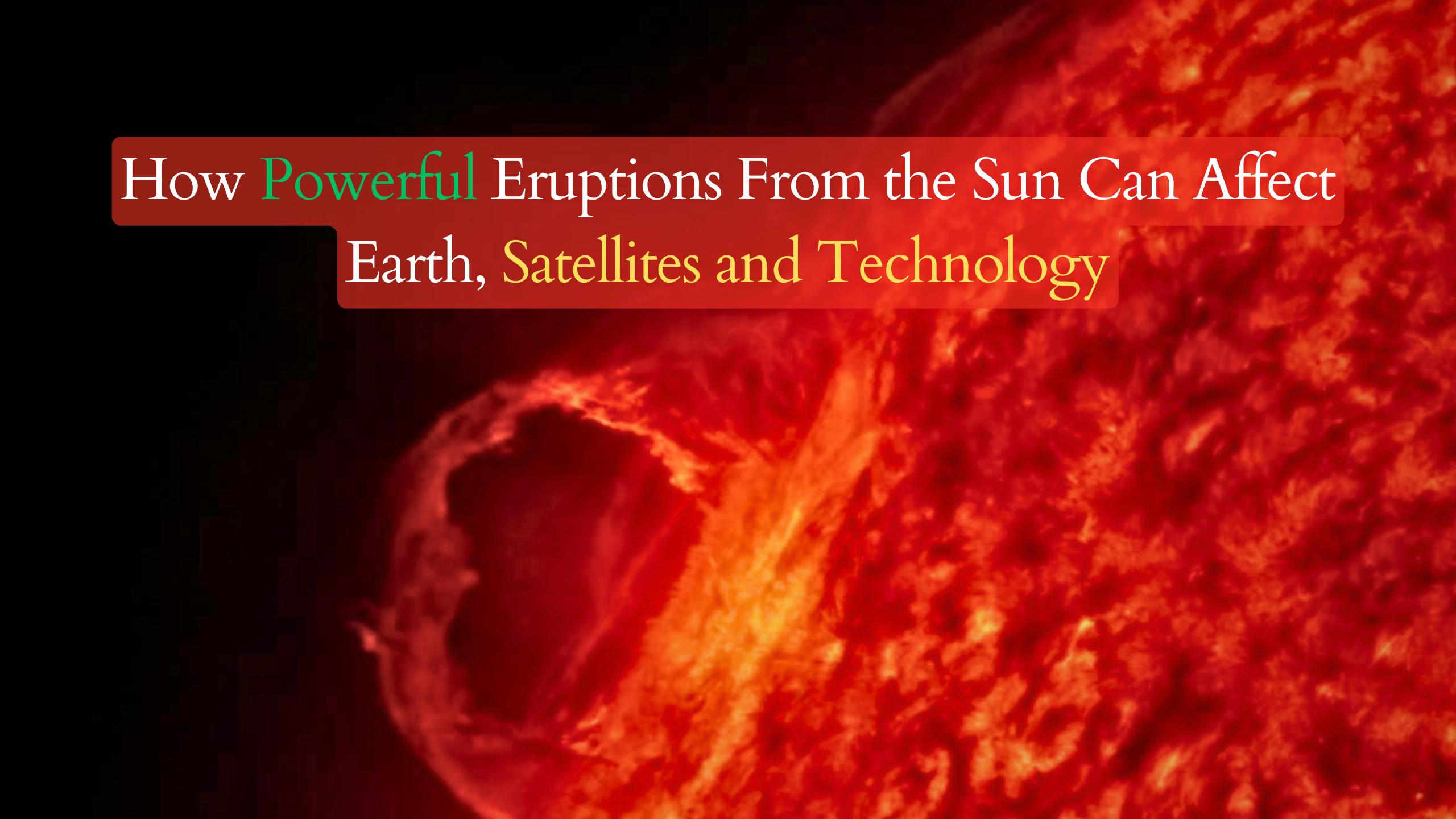
The Sun may look calm from Earth, but its surface and atmosphere are constantly changing. Powerful magnetic activity on the Sun can produce enormous eruptions that send radiation, charged particles and clouds of magnetized plasma into space. When some of these eruptions are directed toward Earth, they can trigger what scientists call space weather events or solar storms.
Solar storms are not ordinary storms like hurricanes or thunderstorms. They occur in space and can interact with Earth's magnetic field and upper atmosphere. Depending on their strength, they can create spectacular auroras while also affecting radio communications, navigation systems, satellites and, in extreme cases, electrical infrastructure.
Recent advances in space-weather forecasting are giving scientists better tools to understand these events. In August 2026, NASA reported that its PUNCH mission had demonstrated the ability to predict the arrival of a solar eruption near Earth to within about 30 minutes in an initial proof-of-concept test. Scientists say improved forecasting could help protect critical infrastructure and spacecraft from future solar storms.
What Is a Solar Storm?
A solar storm is a disturbance in space caused by activity on the Sun. Solar flares and coronal mass ejections (CMEs) are among the most important sources of space weather.
A CME is a huge eruption of plasma and magnetic field from the Sun. If a CME travels toward Earth, it can eventually interact with Earth's magnetic environment.
The effects depend on several factors, including the speed and direction of the eruption and the orientation of its magnetic field when it reaches Earth.
NOAA explains that a geomagnetic storm occurs when energy from the solar wind is efficiently transferred into Earth's magnetosphere, producing major changes in currents, plasma and magnetic fields around the planet.
How Does a Solar Storm Begin?
Solar storms are closely connected to the Sun's magnetic activity.
The Sun is made of extremely hot plasma, and its magnetic fields are constantly moving and changing. Sometimes magnetic fields become concentrated in particular regions, producing sunspots and active regions.
When magnetic energy is suddenly released, the Sun can produce a solar flare. In some cases, the eruption is accompanied by a CME that sends a huge cloud of solar material into space.
NASA researchers are also developing new techniques to identify active regions before they become major sources of solar eruptions. In August 2026, NASA said a machine-learning model developed by its COFFIES team could predict the emergence of active regions on the Sun up to 12 hours before they appear.
Solar Flares and Coronal Mass Ejections Are Different
Solar flares and CMEs are related but are not the same thing.
A solar flare is a sudden release of energy and electromagnetic radiation from the Sun. Strong flares can affect radio communications on Earth, particularly on the side of Earth facing the Sun.
A coronal mass ejection is a huge release of plasma and magnetic field into space. A CME can take much longer to reach Earth than the electromagnetic radiation from a flare.
This difference is important because scientists monitor both phenomena when assessing potential space-weather impacts.
What Happens When a CME Reaches Earth?
Earth is protected by its magnetic field, which acts as an important shield against much of the charged material arriving from space.
When a CME interacts with Earth's magnetosphere, however, it can disturb this magnetic environment. This disturbance is known as a geomagnetic storm.
During a strong geomagnetic storm, electrical currents can be induced in long conductors such as power-transmission systems. Satellites can also experience increased risks, while navigation and radio systems can be affected.
The upper atmosphere can respond as well, producing one of the most beautiful effects of solar storms: the aurora.
Why Solar Storms Produce Auroras
Auroras occur when energetic particles associated with space weather interact with gases in Earth's upper atmosphere.
The interaction causes atmospheric particles to emit light, creating the colourful displays commonly known as the Northern Lights or Aurora Borealis in the Northern Hemisphere and the Southern Lights or Aurora Australis in the Southern Hemisphere.
During particularly strong geomagnetic storms, auroras can become visible much farther from the polar regions than usual.
NOAA has documented major geomagnetic storms producing visible auroras across parts of North America.
Can Solar Storms Affect GPS?
Yes. Space weather can interfere with navigation and positioning systems.
GPS signals travel through Earth's atmosphere, and disturbances in the ionosphere can affect how those signals propagate.
A strong space-weather event may therefore reduce the accuracy or reliability of some navigation services.
This matters because modern society depends on satellite-based positioning for far more than smartphone maps. Transportation, agriculture, communications, logistics and many industrial systems can use satellite navigation.
Can Solar Storms Affect Satellites?
Satellites are particularly exposed to the space environment because they operate above most of Earth's atmosphere.
Solar storms can increase radiation levels and cause problems with satellite electronics. Increased atmospheric density at lower satellite altitudes can also increase drag, potentially affecting satellite orbits.
NOAA notes that space weather can affect satellites, GPS systems, communications and power grids.
Satellite operators therefore monitor space-weather conditions and can take protective measures when significant solar activity is expected.
Could a Solar Storm Cause a Power Outage?
A sufficiently strong geomagnetic storm can create risks for electrical power systems.
Changes in Earth's magnetic field can induce electrical currents in long transmission lines. These currents can interfere with transformers and other infrastructure.
The possibility of widespread disruption depends on the strength and characteristics of the storm, the Earth's magnetic response and the design and location of the affected infrastructure.
History shows that powerful geomagnetic storms can have significant technological consequences.
The Carrington Event
One of the most famous examples is the Carrington Event of 1859, widely regarded as the largest recorded geomagnetic storm.
At that time, society did not depend on satellites, digital communications or modern electrical grids in the way it does today. Telegraph systems were among the most advanced communication technologies of the era, and the storm disrupted telegraph operations.
NOAA says operators reported electrical sparks and fires associated with telegraph equipment during the event.
A similarly powerful event today could pose much greater challenges because modern society depends on interconnected technological infrastructure.
Would a Solar Storm Destroy the Earth?
No.
A solar storm does not have the power to destroy Earth itself. The planet's magnetic field and atmosphere provide significant protection from solar radiation and charged particles.
The main concern is the potential effect on technology and infrastructure.
A major storm could create disruptions in communications, navigation, satellites and electrical systems, but that is very different from physically destroying the planet.
Are People on Earth in Danger?
For most people on Earth's surface, the direct physical danger from a typical geomagnetic storm is limited because Earth's atmosphere and magnetic field provide substantial protection.
The greater concern is technological disruption.
Astronauts and spacecraft can face greater radiation risks during strong solar events because they are outside the protective environment experienced at Earth's surface.
Airlines operating high-latitude routes can also monitor space weather because strong radiation events and communication disruptions can affect aviation operations.
How Scientists Monitor the Sun
Scientists use a network of satellites, ground-based observatories and other instruments to monitor solar activity.
Spacecraft can observe the Sun, measure solar wind conditions and detect changes in the environment between the Sun and Earth.
These observations allow space-weather forecasters to identify solar flares, CMEs and other events.
NOAA's Space Weather Prediction Center provides forecasts, watches and warnings for space-weather conditions.
Why Early Warning Matters
A solar eruption can travel through space for a period of time before reaching Earth.
That creates an opportunity for scientists and infrastructure operators to prepare.
Improved forecasts could allow satellite operators to adjust operations, power companies to take protective measures and other industries to prepare for potential disruptions.
NASA's PUNCH mission is part of the effort to improve this capability. NASA reported in August 2026 that PUNCH imagery had been used to predict the near-Earth arrival of a solar eruption to within approximately 30 minutes during an initial demonstration.
Better forecasting could become increasingly valuable as society becomes more dependent on satellites and electronic infrastructure.
The Sun Goes Through Activity Cycles
Solar activity is not constant.
The Sun experiences an approximately 11-year cycle during which the number of sunspots and the level of solar activity increase and decrease.
Periods of greater solar activity generally provide more opportunities for strong flares and CMEs.
This is why scientists continuously monitor the Sun rather than treating solar storms as completely random events.
Could Solar Storms Affect the Internet?
Solar storms can potentially affect some of the infrastructure that supports modern communications, but claims that a single solar storm will automatically "destroy the internet" are overly simplistic.
Different parts of the internet have different levels of vulnerability. Satellites, navigation systems, power supplies and certain communication technologies can be affected by space weather, while many terrestrial systems may continue operating.
The actual consequences of a major event would depend on its intensity, duration and interaction with technological infrastructure.
Why Solar Storm Forecasting Is Improving
Scientists now have access to more advanced spacecraft and computing technology than ever before.
Satellites can observe solar eruptions from different positions, while computer models can simulate how solar material travels through space.
Artificial intelligence and machine learning are also being explored as tools for identifying patterns associated with solar activity.
NASA's recent research into predicting active solar regions demonstrates how scientists are combining observations with machine-learning techniques to improve space-weather forecasting.
What Should People Do During a Solar Storm?
Most people do not need to panic when a solar storm occurs.
The best approach is to follow information from official space-weather agencies and relevant authorities.
People who depend heavily on satellite navigation, radio communications or other technology should be aware that temporary disruptions are possible during significant events.
For critical services, governments and infrastructure operators maintain their own preparedness procedures.
Why Solar Storms Matter More Today
Humanity has become increasingly dependent on technology in space.
Satellites support weather forecasting, communications, navigation, scientific research and many commercial services.
That means space weather is no longer just a subject for astronomers. It has become an issue relevant to modern infrastructure and national preparedness.
NOAA describes space weather as something that can affect power grids, communications, airline operations and global positioning systems.
What the Future Could Bring
As technology becomes more dependent on satellites and digital systems, understanding space weather will become increasingly important.
Scientists are working to improve forecasts so that warnings can be issued earlier and with greater confidence.
Better observations of the Sun, improved computer models and artificial intelligence could eventually provide more accurate predictions of when an eruption will arrive and how strong its effects might be.
The goal is not to stop solar storms. Humanity cannot control the Sun. Instead, scientists are trying to understand these events well enough to reduce their impact
What is a solar storm?
A solar storm is a disturbance in space caused by solar activity, including solar flares and coronal mass ejections. When such activity interacts strongly with Earth's magnetic field, it can produce a geomagnetic storm.
Can a solar storm affect Earth?
Yes. Strong solar storms can affect satellites, radio communications, navigation systems and electrical infrastructure. They can also produce auroras at lower-than-usual latitudes.
Can solar storms affect mobile phones?
A solar storm does not normally directly damage an individual smartphone. However, disruptions to satellite navigation, communications or electrical infrastructure could indirectly affect some services.
Can a solar storm cause an internet blackout?
A major solar storm could potentially disrupt parts of the infrastructure supporting communications, but it would not automatically shut down the entire internet.
Are solar storms dangerous to humans?
People on Earth's surface are largely protected by the planet's atmosphere and magnetic field. Radiation exposure is a greater concern for astronauts and certain high-altitude or high-latitude aviation operations during significant solar events.
How are solar storms detected?
Scientists use solar observatories, spacecraft, solar-wind measurements and computer models to detect and track solar activity and predict possible impacts on Earth.
Solar storms are powerful reminders that Earth is part of a much larger and constantly changing space environment. Eruptions from the Sun can travel across millions of kilometres and interact with Earth's magnetic field, producing spectacular auroras while also creating challenges for satellites, communications, navigation and power systems.
The good news is that scientists have developed increasingly sophisticated ways to observe and forecast space weather. New missions and technologies, including NASA's PUNCH and machine-learning research, are improving our understanding of solar eruptions and their potential effects.
A major solar storm would not destroy Earth, but it could test modern technological infrastructure. Better forecasting, stronger preparation and continued scientific research can help reduce the risks.
As humanity becomes increasingly dependent on satellites and digital technology, monitoring the Sun will remain an important part of protecting the systems that support everyday life.
Get FlashNews24 App
Get breaking news, India news, World news, technology updates and more directly on your phone.
📱 GET THE APP