
India’s ₹60,000 Crore PM-SETU Plan: 1,000 ITIs to Get a Major Upgrade, What It Means for Jobs and Students
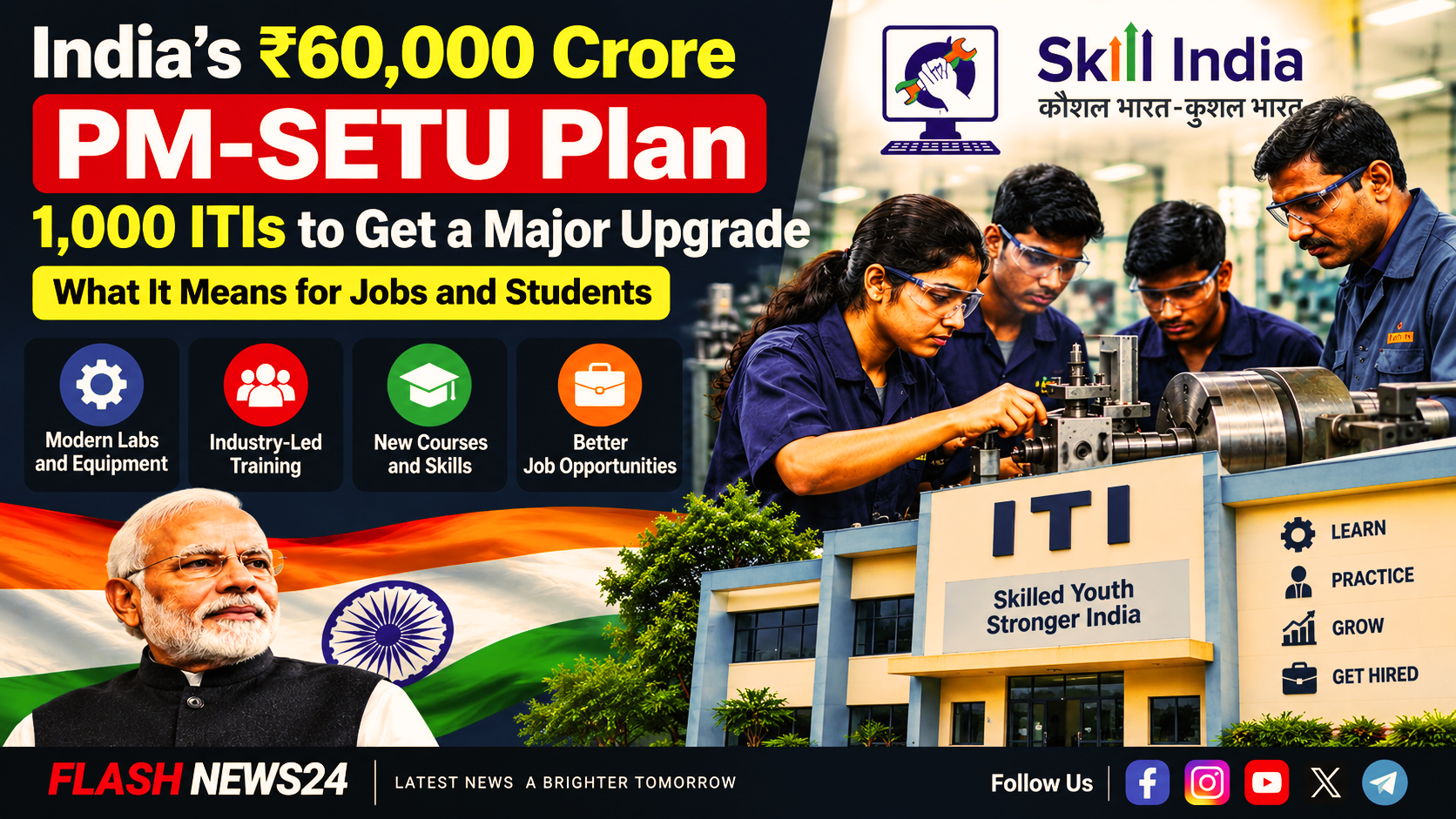
India Pushes a Major Upgrade of Government ITIs
India is preparing for a major transformation of its vocational training system through the Pradhan Mantri Skilling and Employability Transformation through Upgraded ITIs (PM-SETU) scheme.
The government has allocated an estimated ₹60,000 crore for the programme, which aims to upgrade 1,000 government Industrial Training Institutes (ITIs) across the country.
The latest push places greater emphasis on industry participation, modern equipment, updated courses and employment outcomes.
The government has also called on industry to play a stronger role in implementing the programme as India prepares its workforce for changing industrial and technological requirements.
What Is PM-SETU?
PM-SETU stands for Pradhan Mantri Skilling and Employability Transformation through Upgraded ITIs.
It is a centrally sponsored programme designed to improve the quality and relevance of vocational education.
The scheme focuses on transforming government ITIs from conventional training centres into more modern, industry-aligned institutions.
According to the Ministry of Skill Development and Entrepreneurship, the total scheme outlay is ₹60,000 crore, consisting of:
- ₹30,000 crore Central share
- ₹20,000 crore State share
- ₹10,000 crore Industry share
The programme is designed around an industry-linked model rather than government funding alone.
Why Is the Government Upgrading ITIs?
India's economy is changing rapidly.
Manufacturing, electronics, electric mobility, renewable energy, automation, construction, logistics and other industries increasingly require workers with specialised technical skills.
Traditional vocational courses may not always match the equipment and technologies being used by modern companies.
This creates a gap between:
What students learn → What employers need
PM-SETU is intended to reduce that gap.
The government wants ITI courses and training facilities to become more closely connected to actual labour-market requirements.
1,000 Government ITIs Will Be Upgraded
One of the most important features of PM-SETU is its scale.
The programme targets 1,000 government ITIs.
These will be organised using a Hub-and-Spoke model:
200 Hub ITIs
The hub institutions will receive more advanced facilities and serve as major training and innovation centres.
800 Spoke ITIs
The spoke institutions will connect to the hub institutions and extend access to upgraded vocational training across surrounding regions.
This model is designed to spread modern training infrastructure beyond a limited number of large institutions.
What Will Change Inside These ITIs?
The upgrades are expected to cover much more than buildings.
The government has identified areas such as:
- Modern laboratories
- Smart classrooms
- Digital learning content
- New industry-relevant courses
- Modern machinery
- Training-of-trainers facilities
- Innovation and incubation centres
- Placement support
The objective is to create institutions that are better connected to employers and modern production systems.
Industry Will Have a Bigger Role
One of the most important changes under PM-SETU is the stronger involvement of industry.
Instead of designing vocational training entirely from an academic or government perspective, industry partners can help identify the skills companies actually require.
This can influence:
- Course design
- Equipment selection
- Training methods
- Industry exposure
- Apprenticeships
- Placement systems
The scheme uses industry-led Special Purpose Vehicles (SPVs) to help manage upgraded ITI clusters and align training with local industrial needs.
Why Is Industry Participation Important?
Imagine a student learning a technical trade using equipment that is no longer commonly used by employers.
The student may complete the course successfully but still require additional training after joining a company.
That creates a skills mismatch.
Industry participation can help reduce this problem by bringing employers closer to the training process.
For students, the ideal outcome is: Training → Practical experience → Apprenticeship → Job rather than: Training → Course completion → Job search → Additional training
PM-SETU is designed to move vocational education closer to the first model.
Which New Skills Could Become Important?
The programme allows courses to be redesigned according to emerging industry requirements.
Government documents specifically mention areas including:
- Artificial intelligence
- Cybersecurity
- Cloud computing
- Data analytics
- Robotics
- Internet of Things
- Industry 4.0 technologies
Traditional trades can also be modernised with new technology rather than being abandoned completely.
This is important because India's future workforce will need both traditional technical skills and newer digital capabilities.
What Does This Mean for ITI Students?
For students, the biggest potential benefit is access to better training infrastructure.
A modernised ITI could provide:
- Better equipment
- More practical training
- Updated curriculum
- Industry exposure
- Apprenticeship opportunities
- Better placement support
However, students should not assume that joining an upgraded ITI automatically guarantees a job.
Employment will still depend on the student's skills, performance, local industry demand and available opportunities.
The real value of the programme will depend on how effectively the upgraded facilities are used.
Could PM-SETU Improve Employment?
Potentially, yes.
The scheme specifically focuses on employability and industry alignment
If courses are designed around actual vacancies and employers participate in training, students may have a better chance of acquiring skills relevant to available jobs.
The government is also emphasising outcome-based training and stronger industry partnerships.
But employment outcomes cannot be guaranteed simply because an ITI receives funding.
The quality of implementation will matter enormously.
What About Apprenticeships?
Apprenticeships can be an important bridge between classroom learning and employment.
Students get exposure to real workplaces while developing practical skills.
Industry-linked ITIs can potentially create stronger pathways between training and apprenticeship opportunities.
This could be particularly valuable in sectors such as manufacturing, engineering, electronics, automotive and energy.
The exact number of apprenticeship opportunities generated will depend on participating companies and local industrial demand.
Five National Centres of Excellence
PM-SETU is not limited to upgrading 1,000 ITIs.
The programme also includes capacity augmentation of five National Skill Training Institutes (NSTIs).
These are located in:
- Bhubaneswar
- Chennai
- Hyderabad
- Kanpur
- Ludhiana
The centres are intended to support advanced training, including training of trainers and sector-specific Centres of Excellence.
This matters because improving teachers and trainers is just as important as improving machines and classrooms.
How Much Money Is Actually Going Into ITI Upgrades?
The overall PM-SETU scheme has a ₹60,000 crore estimated outlay.
According to Ministry of Skill Development and Entrepreneurship documents, approximately ₹56,900 crore is allocated to upgrading the 1,000 ITIs under the main infrastructure component.
That includes approximately:
₹20,220 crore for 200 Hub ITIs
and
₹36,680 crore for 800 Spoke ITIs.
The remaining portion of the overall scheme is directed towards the five National Centres of Excellence and central activities.
What Is the Current Status?
The programme is moving from planning toward wider implementation.
The government reported in July 2026 that the scheme was progressing through state-level structures and industry participation.
Earlier in May, the Visakhapatnam ITI Cluster in Andhra Pradesh became the first to receive National Steering Committee approval for a Strategic Investment Plan under PM-SETU.
That project involved ArcelorMittal Nippon Steel India as the industry partner and was described by the government as the first operational industry partnership under the scheme.
This is significant because it shows how the industry-led model is beginning to move from policy design toward actual implementation.
How Many ITIs Are There in India?
India's ITI network has expanded significantly.
According to government data, the number of ITIs increased from 9,642 in 2014 to 13,856 in 2026.
ITI enrolment also increased from 9.51 lakh students in 2014–15 to 14.70 lakh in 2025–26.
That means modernising ITIs can potentially affect a very large student population.
Will Every ITI Become a Centre of Excellence?
No.
The programme specifically targets 1,000 government ITIs.
The Hub-and-Spoke model means some institutions will function as advanced hubs while others will operate as connected spoke institutions.
Therefore, it would be incorrect to say that every ITI in India will immediately receive the same level of infrastructure.
The selection and implementation process involves state governments and industry participation.
Why This Matters for Students Who Cannot Afford Expensive Degrees
Not every student needs a traditional university degree to build a career.
Vocational education can provide pathways into technical occupations through practical training.
For students interested in areas such as:
- Electrical work
- Mechanical trades
- Automotive technology
- Electronics
- Manufacturing
- Welding
- Refrigeration
- Industrial maintenance
- Digital technologies
an upgraded ITI could provide a more practical route into the workforce.
The challenge is ensuring that these courses lead to real skills and meaningful employment opportunities.
Could ITIs Become More Attractive to Young People?
That is one of the government's broader objectives.
For years, vocational education has sometimes been viewed as a second choice compared with conventional academic education.
Modern equipment, better facilities, industry exposure and clearer employment pathways could help change that perception.
If students can see a realistic connection between an ITI course and a career, vocational education can become a more attractive option
What Are the Biggest Challenges?
The scale of PM-SETU is also its biggest challenge.
Upgrading 1,000 institutions across different states will require coordination between:
- Central government
- State governments
- Industry partners
- ITI management
- Trainers
- Students
- Local employers
Another challenge is keeping equipment and curricula updated.
Technology changes quickly.
A laboratory that is modern today can become outdated within a few years.
Therefore, ITI modernisation cannot be treated as a one-time construction project.
It needs continuous investment, trainer development and regular curriculum updates.
What Should Students Do Now?
Students should not wait for every PM-SETU upgrade to be completed before developing their skills.
They can strengthen their employability by:
1. Building strong practical skills.
2. Learning basic digital tools.
3. Looking for apprenticeship opportunities.
4. Following developments in their chosen industry.
5. Improving communication skills.
6. Learning safety procedures.
7. Building problem-solving abilities.
8. Checking placement and training opportunities at their institution.
Government infrastructure can provide better opportunities, but students still need to make active use of them.
Frequently Asked Questions
What is PM-SETU?
PM-SETU is the Pradhan Mantri Skilling and Employability Transformation through Upgraded ITIs scheme, designed to modernise government ITIs and make vocational training more closely aligned with industry needs.
How much money has been allocated?
The scheme has an estimated total outlay of ₹60,000 crore.
How many ITIs will be upgraded?
The programme aims to upgrade 1,000 government ITIs — 200 Hub ITIs and 800 Spoke ITIs.
Will PM-SETU guarantee students jobs?
No. The scheme aims to improve employability and industry alignment, but employment depends on skills, performance, vacancies and other factors.
What modern skills can be introduced?
Government documents mention areas such as AI, cybersecurity, cloud computing, data analytics, robotics, IoT and Industry 4.0 technologies.
Will private companies participate?
Yes. Industry participation is a central feature of the programme, including industry-led Special Purpose Vehicles for ITI clusters.
Which NSTIs are being developed as National Centres of Excellence?
The five locations are Bhubaneswar, Chennai, Hyderabad, Kanpur and Ludhiana.
India's ₹60,000 crore PM-SETU programme represents a major attempt to modernise the country's vocational education system.
Upgrading 1,000 government ITIs, introducing modern equipment and courses, strengthening industry partnerships and improving apprenticeship and placement pathways could make vocational education more relevant to India's changing economy.
But the success of PM-SETU will not be measured by how much money is spent or how many buildings are upgraded.
The real test will be much simpler:
Are students learning skills that employers actually need, and are those skills helping them build sustainable careers?
If the industry-led model works as intended, India's ITIs could become important training centres for the next generation of manufacturing, engineering, technology and energy workers.
For millions of young Indians, that could make vocational education a much stronger pathway to employment.
FlashNews24 will continue tracking PM-SETU implementation, ITI upgrades, new courses and major skill-development opportunities across India.
Disclaimer: This article is for general informational purposes. PM-SETU implementation, ITI selection, courses, industry partnerships and employment outcomes may vary by state and institution. Students should verify current course and admission information directly with the relevant ITI or government authority.
Sources: Ministry of Skill Development and Entrepreneurship; Press Information Bureau; Government of India.
Get FlashNews24 App
Get breaking news, India news, World news, technology updates and more directly on your phone.
📱 GET THE APP