
NASA Hubble Finds a Strange 10-Sided Pattern at Saturn’s South Pole
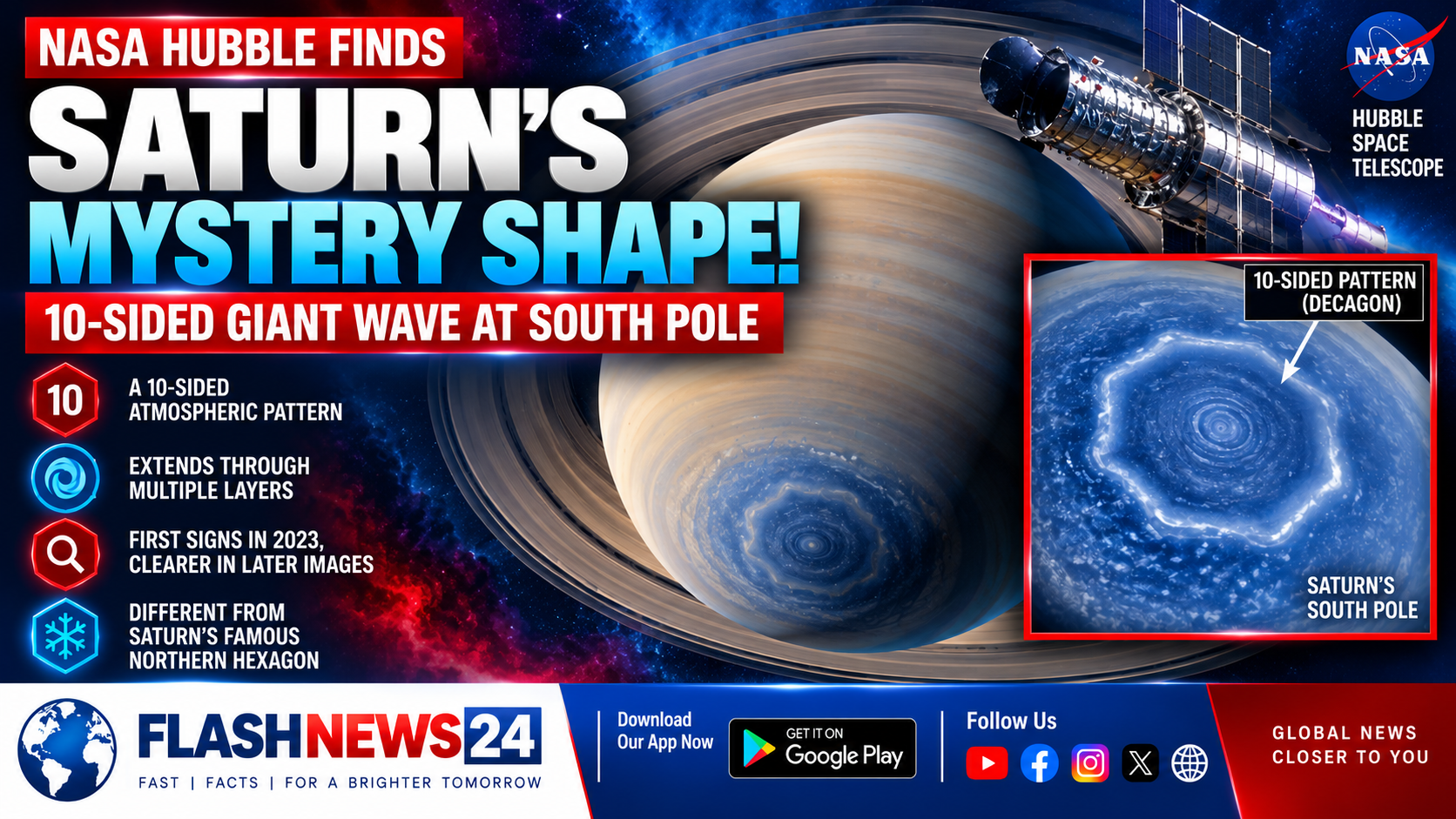
NASA’s Hubble Space Telescope has revealed a surprising feature around Saturn’s south pole — a giant 10-sided atmospheric wave that stretches through multiple layers of the planet’s atmosphere.
The discovery is especially interesting because Saturn is already famous for another unusual atmospheric shape: the long-lasting hexagon at its north pole. Scientists have now found a distinctly different geometric pattern developing in the southern hemisphere.
What did Hubble discover?
Researchers studying Hubble observations found a large atmospheric structure surrounding Saturn’s south pole.
The feature has 10 distinct sides, giving it the appearance of a giant decagon. Scientists found evidence that the structure was already beginning to emerge in observations from 2023 and became more clearly visible in later images.
Unlike a simple cloud pattern, the feature appears to extend through several layers of Saturn’s atmosphere.
That makes the discovery particularly important for scientists trying to understand how Saturn’s powerful winds and atmospheric currents behave.
Saturn already has a famous hexagon
Saturn’s north pole has been known for decades for its enormous six-sided atmospheric pattern.
The northern hexagon was closely studied by NASA’s Cassini spacecraft, which orbited Saturn from 2004 to 2017.
Scientists had long wondered whether Saturn’s southern pole might contain a similar feature.
However, Cassini observations did not reveal a long-lasting southern counterpart.
The new Hubble observations have now provided evidence of a different pattern — a 10-sided wave rather than a six-sided one.
Why is the shape important?
The shape is not simply a strange-looking cloud.
Saturn’s atmosphere contains powerful jet streams, and the newly observed structure sits within one of them.
Scientists believe atmospheric waves and jet streams can interact to produce large-scale geometric patterns.
Studying the new decagon could therefore help researchers understand how planetary atmospheres behave under extreme conditions.
Because Saturn has no solid surface like Earth, its atmosphere provides a natural laboratory for studying large-scale fluid dynamics.
How did scientists find it?
The discovery was possible because researchers combined observations from different years.
Hubble’s high-resolution view allows scientists to observe Saturn without the distortion caused by Earth’s atmosphere.
Researchers examined images dating back to 2023, when early signs of the unusual southern-pole pattern could be detected.
Additional observations in 2024 and 2025 helped reveal how the structure developed over time.
The feature had also been hinted at in observations made from Earth, but Hubble provided clearer evidence of its structure.
Is it exactly like Saturn’s northern hexagon?
No.
Although both structures are geometric atmospheric patterns, scientists say the southern decagon is different from the famous northern hexagon.
The northern feature has six sides and has remained remarkably persistent.
The newly observed southern structure has 10 sides and appears to be an evolving phenomenon.
Scientists are still working to understand why the two poles behave differently.
What causes these strange patterns?
Saturn’s atmosphere is dominated by hydrogen and helium and contains extremely powerful winds.
When atmospheric currents move at different speeds, they can create waves and rotating structures.
Under certain conditions, these waves can form surprisingly regular shapes.
Earth also has atmospheric waves and jet streams, but Saturn provides a much larger and more extreme environment in which these processes can produce enormous structures.
The discovery gives researchers another opportunity to study these atmospheric dynamics.
Why Hubble is important
Space telescopes such as Hubble can observe planets without having to look through Earth’s turbulent atmosphere.
That makes it easier to detect subtle changes in distant planetary atmospheres.
Hubble has continued observing Saturn even after the end of the Cassini mission, giving scientists another way to monitor changes on the giant planet.
The latest discovery shows why long-term observations are valuable.
A feature that might appear insignificant in a single photograph can become much more interesting when scientists compare images collected over several years.
What could scientists learn next?
Researchers will continue monitoring Saturn’s south pole to determine how stable the decagon is.
One major question is whether the structure will continue growing, change shape or eventually disappear.
Scientists also want to understand why the southern atmosphere developed this pattern while the northern hemisphere contains a very different six-sided structure.
Long-term observations could provide clues about Saturn’s seasonal changes and atmospheric circulation.
Why this discovery matters
At first glance, a 10-sided pattern on Saturn may seem like a fascinating space photograph and nothing more.
But discoveries like this can improve our understanding of how planetary atmospheres work.
The laws of physics that control atmospheric motion operate across the solar system.
By studying extreme examples on planets such as Saturn, scientists can test atmospheric models and compare them with what happens on Earth and other worlds.
The discovery also demonstrates the importance of continuing observations of planets that scientists have already studied for decades.
The bigger picture
Saturn continues to surprise scientists even after decades of exploration.
The planet’s rings, moons, storms and unusual atmospheric behaviour have made it one of the most interesting worlds in our solar system.
The discovery of the southern decagon adds another mystery to that list.
It also shows that Saturn is not a static planet. Its atmosphere is constantly changing, and some of those changes can take years to become visible.
Bottom Line
NASA’s Hubble Space Telescope has identified a remarkable 10-sided atmospheric wave around Saturn’s south pole.
The structure is different from Saturn’s famous northern hexagon and appears to extend through multiple atmospheric layers.
Scientists are now studying how the feature formed and how it may change over time.
For space researchers, the discovery offers a new opportunity to understand the powerful winds and atmospheric waves shaping one of the solar system’s most fascinating planets.
Get FlashNews24 App
Get breaking news, India news, World news, technology updates and more directly on your phone.
📱 GET THE APP