
WHO Warns of 11.1 Million Global Health Worker Shortage by 2030
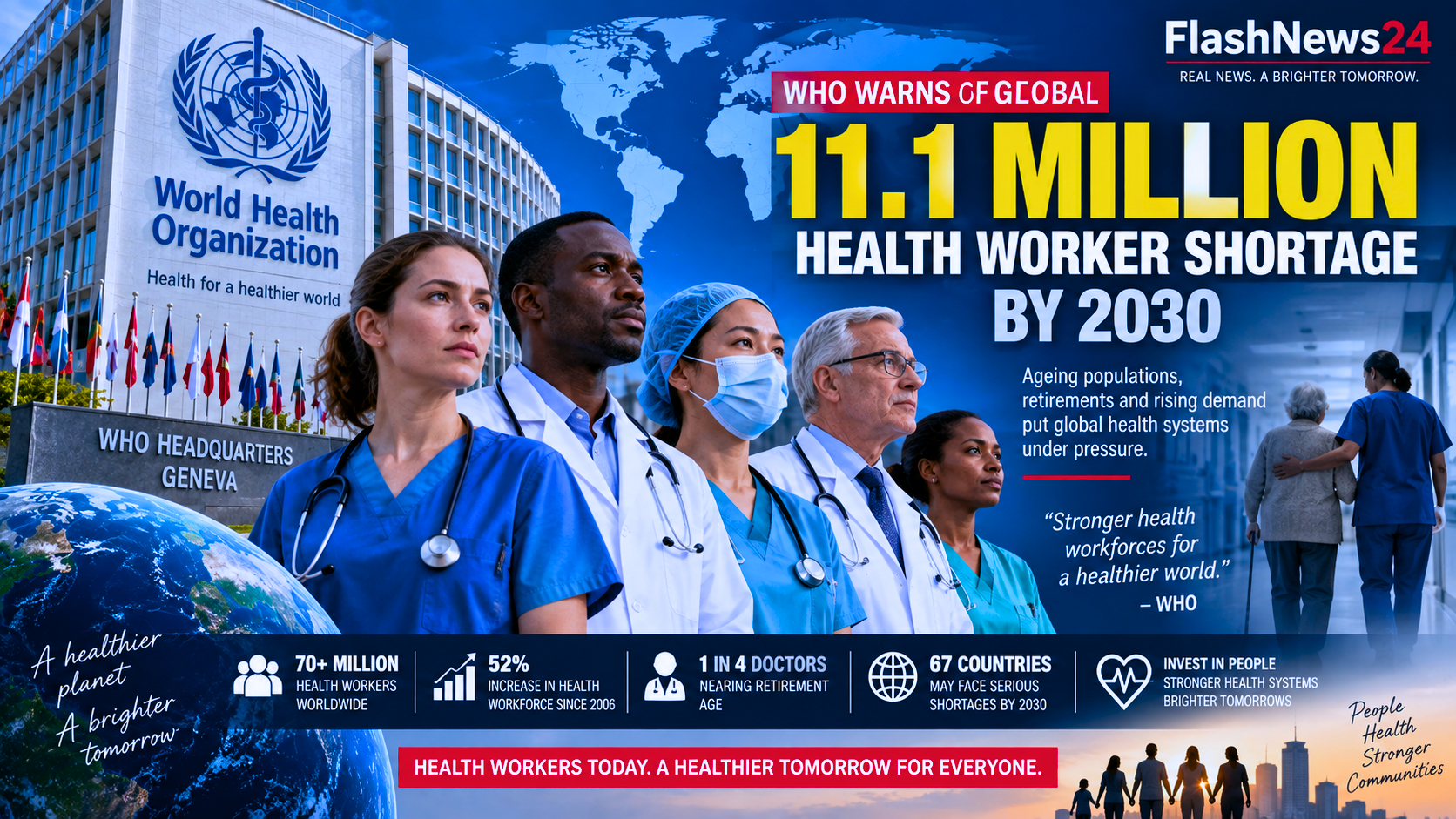
Geneva, September 19, 2026: The World Health Organization (WHO) has warned that the world could face a shortage of 11.1 million health and care workers by 2030, as ageing populations increase demand for medical services while a large share of the existing healthcare workforce approaches retirement.
The warning comes from the WHO's new National Health Workforce Accounts: Health Workforce Levels and Trends 2026, released on September 18. The report provides one of the most detailed global assessments yet of the size, distribution and ageing of the healthcare workforce.
The findings highlight a growing challenge for health systems worldwide: simply increasing the number of healthcare workers may not be enough unless countries can also train, retain and distribute them where they are most needed.
Global Health Workforce Has Grown — But Shortages Remain
The WHO report shows that the global health workforce has expanded substantially over the past two decades.
Health workforce density increased by 52% between 2006 and 2025, rising from 44.8 health workers per 10,000 people to 67.9 per 10,000. The global health and care workforce now includes more than 70 million workers.
Despite that progress, major differences remain between countries and regions.
According to WHO, the density of medical doctors in the WHO European Region is around 13 times higher than in the WHO African Region. The density of nurses and midwives is approximately six times higher in the European Region.
This means that the global problem is not simply a shortage of healthcare professionals. Where those professionals are located is also a major issue.
Ageing Doctors Could Increase Pressure on Health Systems
One of the most important findings in the new report is the ageing of the medical workforce.
Data from 122 countries shows that nearly one in four doctors is older than 55 and could retire within the next decade. In high-income countries, the proportion rises to almost one in three.
That creates a difficult situation for governments and healthcare systems.
As experienced doctors, nurses and other professionals retire, countries will need to replace them while simultaneously responding to growing healthcare demand from ageing populations.
The result could be a double pressure on health systems: fewer available workers at the same time that more people require healthcare services.
67 Countries Could Face Serious Workforce Pressure
The WHO estimates that 67 countries may not have enough health workers by 2030 to maintain the level of population health services they currently provide.
The organization says ageing populations are an important factor behind rising demand. As people live longer, healthcare systems must manage more chronic conditions, long-term care requirements and age-related health needs.
This makes workforce planning increasingly important.
Countries need to look beyond the number of medical graduates they produce each year. They also need to consider whether healthcare workers remain in the profession, whether they are distributed fairly across regions and whether there are enough specialists and primary-care professionals to meet changing demand.
Rich and Poor Countries Face Different Challenges
The WHO data also highlights a major global inequality in healthcare access.
Higher-income countries generally have much greater health-worker density than lower-income countries. At the same time, some wealthy countries are facing a rapidly ageing workforce and may need to recruit additional workers internationally.
Lower-income countries, meanwhile, can face shortages of doctors, nurses and other healthcare professionals even before large numbers of existing workers reach retirement age.
This creates another international challenge: health-worker migration.
Professionals trained in countries with limited healthcare resources may move to countries offering higher salaries, better working conditions or greater career opportunities.
WHO has highlighted the need for ethical approaches to international recruitment so that migration does not further weaken already understaffed health systems.
Why the Shortage Matters for Patients
A shortage of healthcare workers can have consequences beyond hospitals and clinics.
When medical systems do not have enough staff, patients can experience longer waiting times, reduced access to primary care and greater pressure on existing workers.
Shortages can also affect emergency services, maternity care, nursing, elderly care and treatment for chronic diseases.
For rural and remote communities, the impact can be particularly significant because healthcare professionals are often concentrated in major cities.
The WHO's findings therefore point to a broader question about healthcare access: how can countries ensure that population growth and ageing do not outpace the capacity of their health systems?
Training More Healthcare Workers Will Be Important
One major response will be expanding education and training.
Governments may need to increase medical and nursing-school capacity, improve clinical training facilities and create pathways that allow healthcare professionals to continue developing their skills throughout their careers.
However, training alone will not solve the problem.
Healthcare systems also need to retain existing workers by improving working conditions, career opportunities and workforce planning.
If newly trained professionals leave the profession or migrate because of poor working conditions, countries may struggle to close the gap despite increasing education capacity.
Better Data Could Help Governments Plan Ahead
The WHO report also highlights progress in health workforce data collection.
More than 90% of WHO Member States actively reported health workforce data in 2025, according to the organization. WHO says the availability of health workforce data has increased dramatically since its National Health Workforce Accounts system was launched in 2017.
Better data can help governments identify where shortages are developing before they become severe.
For example, a country can use workforce data to determine how many doctors and nurses are expected to retire, how many new professionals are entering the system and which regions have the greatest shortages.
This allows governments to plan education, recruitment and healthcare investment years ahead rather than responding after shortages become critical.
The Next Four Years Will Be Important
The projected 11.1 million-worker global gap by 2030 gives governments a relatively short period to prepare.
The challenge will vary considerably between countries. Some will need to focus heavily on training new workers, while others may need to address retirement, retention or regional distribution.
The ageing of both healthcare workers and patients means that workforce planning will increasingly become a long-term economic and public-service issue.
Healthcare systems are also likely to face pressure from technological changes, including artificial intelligence, digital health services and remote consultations. These technologies may improve productivity in some areas, but they are unlikely to eliminate the need for trained healthcare professionals.
What the WHO Warning Means for the World
The WHO's latest assessment shows that the global healthcare workforce has made significant progress in recent decades, but that progress is uneven.
The world now has more than 70 million health and care workers, yet millions more may be needed to meet future demand. At the same time, a significant portion of today's doctors and other healthcare professionals are approaching retirement age.
The projected 11.1 million health-worker shortage by 2030 is therefore not simply a numbers problem. It involves education, migration, workforce retention, healthcare investment and the unequal distribution of professionals between countries and regions.
For governments, the message is clear: planning for the healthcare workforce of the 2030s needs to begin well before the shortage arrives.
FlashNews24 will continue tracking major global developments in healthcare, technology, business and international affairs.
Get FlashNews24 App
Get breaking news, India news, World news, technology updates and more directly on your phone.
📱 GET THE APP