
Wipro AI Push: What 20,000 Employees’ Worth of Productivity Means for India’s IT Jobs
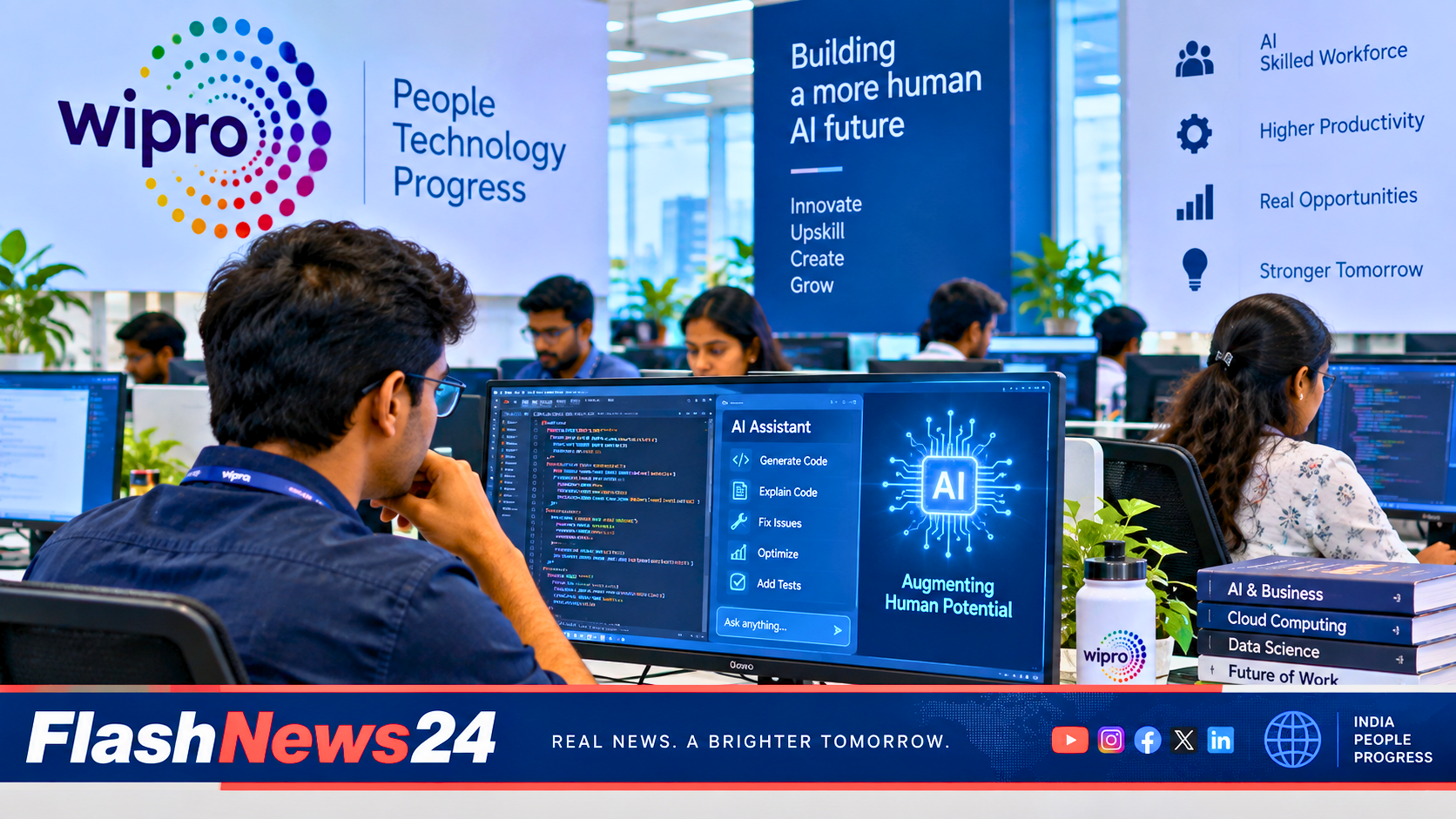
Artificial intelligence is beginning to change the way India's technology companies organise work. One of the clearest recent examples comes from Wipro, which says its AI initiatives have generated productivity gains equivalent to the work of around 20,000 employees.
But there is an important detail behind that headline: Wipro has said this does not mean 20,000 employees were laid off. Instead, the company says the capacity created through AI has allowed employees to be redeployed into other roles and projects.
The development offers a useful look at how AI could reshape India's IT industry over the coming years.
What Does “20,000 Employees’ Worth of Productivity” Mean?
The figure does not mean that Wipro has replaced 20,000 people with machines.
Instead, it represents an estimate of the amount of work that can now be completed because AI tools have increased productivity across different activities.
For example, if an engineer can use AI tools to complete certain coding, testing or documentation tasks in less time, that employee can potentially spend the remaining time on higher-value work.
When similar productivity improvements happen across a large organisation, the total capacity can become equivalent to the work previously associated with thousands of employees.
That is the context behind Wipro's 20,000 figure.
Wipro Is Redeploying Employees
Wipro's approach is particularly important because the company says the additional capacity is being redeployed rather than treated simply as job reductions.
Employees can potentially move into projects where demand is growing or into roles that require newer technical capabilities.
This model reflects a broader change taking place in the IT-services industry. Companies are increasingly looking at how existing employees can work alongside AI rather than treating AI only as an automation tool.
The result could be a workforce in which fewer hours are spent on repetitive tasks and more time is spent on engineering, client interaction, problem-solving and AI implementation.
More Than 100,000 Employees Are Being Trained
Wipro is also investing heavily in AI skills.
The company has said that more than 100,000 employees have received advanced AI training and certifications as it moves towards what it describes as a human-AI operating model.
This matters because simply providing employees with AI software does not automatically create business value.
Workers need to understand how to use these systems responsibly, check AI-generated output and combine AI capabilities with their own technical and business knowledge.
How Could AI Change IT Jobs?
The biggest change may not be the disappearance of entire professions. Instead, individual jobs could contain a different mix of responsibilities.
A software developer, for example, may increasingly use AI assistants for code generation, testing and debugging. That does not remove the need for engineering knowledge. It can shift the engineer's time towards architecture, reviewing AI-generated code, solving complex problems and understanding customer requirements.
Similar changes could happen in data analysis, cybersecurity, customer support, finance operations and other technology-enabled functions.
In other words, AI can automate tasks without necessarily eliminating the entire job.
Why Companies Are Hiring for Different Skills
As AI becomes more deeply integrated into business operations, companies need employees who can connect technology with real-world business problems.
This is one reason roles involving AI engineering, cloud technology, data, cybersecurity and client-facing technology implementation are becoming increasingly important.
Wipro has also been expanding its use of forward-deployed engineers — professionals who work closely with customers to help implement technology and AI solutions.
The broader trend suggests that technical employees may increasingly be expected to do more than write code. Understanding business requirements and delivering measurable outcomes could become equally important.
Does This Mean Fewer Freshers Will Get Jobs?
Not necessarily, but the entry-level job market could become more competitive.
If AI allows experienced employees to complete routine work faster, companies may need fewer people for some repetitive tasks. At the same time, businesses could create new roles around AI development, implementation, governance, cybersecurity and data.
The challenge for fresh graduates will be developing skills that go beyond basic knowledge.
Students and early-career professionals who understand programming fundamentals, databases, cloud platforms and software engineering — while also learning how AI systems work — could be better prepared for this changing environment.
Communication and problem-solving skills will also matter because many technology roles increasingly involve working directly with customers and business teams.
Productivity Is Not the Same as Revenue
There is another important point that businesses need to consider.
An AI system can make employees more productive, but productivity gains alone do not guarantee higher revenue or profits.
Companies ultimately need to turn those efficiency improvements into better products, stronger customer relationships, lower costs or new sources of revenue.
That is why the next stage of the AI transformation will be measured not only by how much work AI can automate, but also by whether companies can successfully commercialise those capabilities.
What This Means for Indian IT Workers
The Wipro example provides a useful message for India's large technology workforce.
AI adoption does not automatically mean that millions of IT jobs will disappear. But it does mean that the nature of many jobs is likely to change.
Employees who continue learning and can use AI as a productivity tool may have an advantage over those who rely entirely on repetitive processes.
The most valuable combination could increasingly be strong technical fundamentals + AI skills + business understanding + human judgement.
Wipro's AI transformation is part of a much larger shift happening across India's software-services industry.
Indian IT companies are experimenting with AI-powered development, automated workflows, AI agents and new ways of delivering services to international clients.
The companies that succeed will not simply be those that automate the most tasks. They will be the ones that can combine technology with skilled employees and convert productivity improvements into better business outcomes.
Wipro's claim that AI has created productivity equivalent to around 20,000 employees is significant, but it should not be interpreted as 20,000 jobs disappearing.
The company's stated approach is to redeploy employees while investing in advanced AI training.
For India's IT workforce, the bigger lesson is clear: AI is changing what employees do, even when it does not eliminate their jobs.
The future of technology employment is likely to belong increasingly to professionals who can work effectively with AI, understand complex business problems and use technology to deliver masurable results
Get FlashNews24 App
Get breaking news, India news, World news, technology updates and more directly on your phone.
📱 GET THE APP