NASA’s Swift Satellite Rescue Mission Fails: Why the LINK Spacecraft Could Not Save the Aging Space Telescope
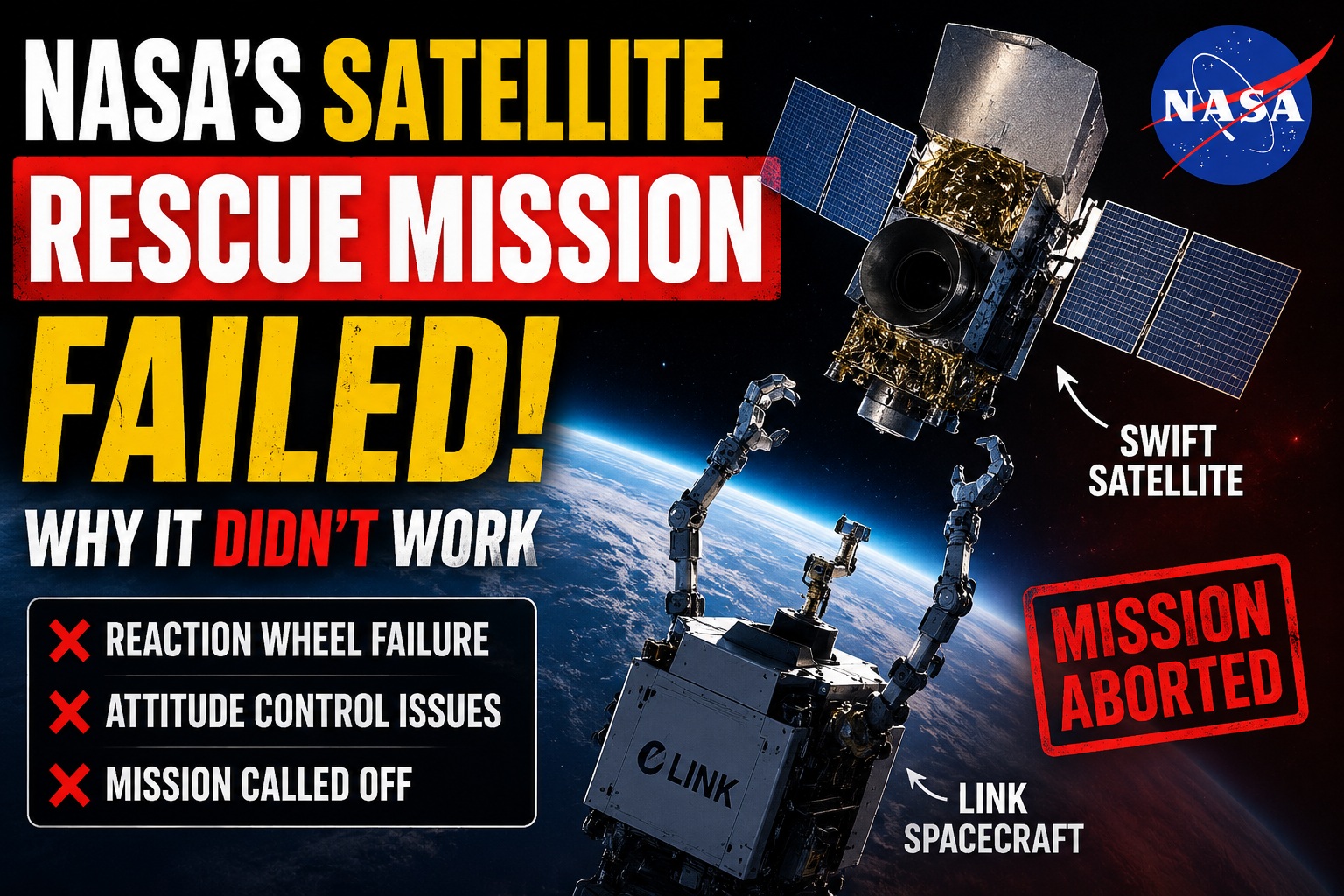
NASA’s ambitious attempt to rescue its aging Neil Gehrels Swift Observatory has been called off after the commercial spacecraft designed to perform the rescue could not overcome serious attitude-control problems in orbit. NASA and Katalyst Space Technologies announced on August 19, 2026, that the LINK spacecraft would no longer attempt to capture and raise Swift into a higher orbit. Instead, LINK will continue with a limited rendezvous and proximity-operations demonstration to gather valuable data for future satellite-servicing missions.
The failure is significant because the mission was designed to demonstrate a technology that could become increasingly important as more satellites reach the end of their operational lives. Rather than abandoning an aging spacecraft when its orbit begins to decay, a servicing vehicle could potentially approach it, attach itself, and move it into a safer or more useful orbit. The Swift Boost Mission was intended to demonstrate exactly that capability.
What Was NASA Trying to Rescue?
The spacecraft at the center of the mission is NASA’s Neil Gehrels Swift Observatory, an astrophysics satellite that has been operating since 2004. Swift is designed to observe some of the most powerful and violent events in the universe, including gamma-ray bursts, using instruments that observe in gamma rays, X-rays and ultraviolet light.
After more than two decades in low Earth orbit, Swift's altitude began falling. Every spacecraft operating in low Earth orbit experiences a small amount of atmospheric drag. Although the atmosphere is extremely thin at satellite altitude, that drag gradually slows spacecraft and causes their orbits to decay if they do not have enough propulsion to maintain altitude.
The situation became more urgent because increased solar activity heated and expanded Earth's upper atmosphere. That increased atmospheric drag on Swift and caused its orbit to fall faster than NASA had originally anticipated.
NASA had already been working to keep Swift above the altitude needed for the rescue attempt. The agency determined that a servicing spacecraft could potentially extend Swift's life by moving it back toward a much higher orbit.
NASA Turned to a Private Space Company
Instead of designing and operating a traditional NASA spacecraft for the rescue, NASA contracted Katalyst Space Technologies, a commercial space company based in Arizona, to develop the servicing vehicle.
The resulting spacecraft was called LINK. It was designed specifically to approach Swift, inspect it, grab it using robotic arms and then gradually raise the observatory's orbit.
NASA awarded the contract in September 2025, leaving Katalyst less than a year to design, build, test and launch LINK. NASA itself described the mission as a fast, high-risk, high-reward effort because Swift's declining orbit created a very tight schedule.
LINK weighed about 880 pounds, or roughly 400 kilograms, and carried three robotic arms. Its mission required extremely precise navigation because the servicing spacecraft would have to approach another spacecraft already traveling around Earth at enormous speed.
The spacecraft was launched on July 3, 2026, aboard a Northrop Grumman Pegasus XL rocket launched from the Marshall Islands. After reaching orbit, LINK began its commissioning process before attempting to approach Swift.
What Went Wrong With LINK?
The main problem was attitude control.
In space, a spacecraft must constantly control its orientation. It needs to know which direction it is pointing and must be able to rotate itself accurately. This is especially important for a spacecraft attempting to rendezvous with and physically grab another satellite.
LINK encountered serious problems with its attitude-control system several weeks after launch.
NASA reported that two of LINK's three reaction wheels became inoperable, while the spacecraft also experienced a loss of functionality in its cold-gas thruster system. The combination caused LINK to begin spinning and resulted in intermittent communications with ground controllers.
Reaction wheels are devices used by spacecraft to change their orientation without continuously firing conventional thrusters. By accelerating or slowing a wheel inside the spacecraft, engineers can make the spacecraft rotate in the opposite direction.
LINK was supposed to use its attitude-control systems to point its sensors, maneuver precisely and eventually position itself correctly next to Swift.
With two of its three reaction wheels unavailable, however, the spacecraft lost a major part of its normal ability to control its orientation.
Engineers Tried to Recover the Mission
The failure did not immediately end the mission.
Katalyst engineers worked with NASA to stabilize LINK and regain control. Teams managed to reduce the spacecraft's spin, and Katalyst later uploaded a flight-software update that restored attitude control to a degree. NASA reported on August 11 that the software update had reestablished attitude control.
That recovery effort demonstrated that the spacecraft was not simply dead. Engineers could still communicate with it and operate it to some extent.
However, the original rescue mission required much more than simply keeping LINK alive.
The spacecraft needed to perform a highly precise rendezvous with Swift. It then needed to approach the telescope safely, inspect its exterior, determine the correct attachment points and use its robotic arms to capture it.
After that, LINK would have needed to apply controlled forces to the much larger Swift observatory and gradually raise its orbit.
Those operations require extremely accurate attitude and navigation control. A spacecraft that cannot reliably maintain its orientation cannot safely perform such a delicate docking and orbital maneuver.
Why NASA Finally Called Off the Rescue
On August 19, NASA and Katalyst concluded that the continuing attitude-control problem meant LINK could no longer safely perform the planned capture and orbital boost.
NASA's official update says LINK will not capture or boost Swift to a higher altitude as originally planned. However, the spacecraft will still attempt rendezvous and proximity operations near Swift to demonstrate capabilities that could help future space missions.
This distinction is important.
The mission was not simply abandoned after the spacecraft experienced a problem. Engineers recovered enough control to potentially use LINK for another purpose: getting close to Swift and collecting information about operating around another satellite.
That data could be valuable for future robotic servicing spacecraft.
Why Was the Mission So Difficult?
One of the biggest reasons was time.
Normally, a spacecraft intended to perform a complicated orbital servicing operation would go through years of design, testing and preparation. The Swift rescue mission was different.
NASA awarded the contract to Katalyst in September 2025, and the company had less than a year to get LINK ready for launch and then attempt the rescue. NASA acknowledged before launch that the rapidly falling orbit of Swift meant the schedule itself was forcing the mission team to accept more risk than would be normal.
The spacecraft also had to solve several difficult problems at once.
First, LINK had to reach the correct orbit. Second, it had to find Swift. Third, it had to match Swift's motion. Fourth, it had to approach without colliding with the observatory. Fifth, it had to identify a suitable place to attach its robotic arms. Finally, it had to generate enough controlled force to raise Swift's orbit.
Every stage depended on accurate navigation and attitude control.
A failure in the spacecraft's ability to control its orientation therefore affected the most important parts of the mission.
What Happens to Swift Now?
The failure means Swift is expected to continue losing altitude rather than receiving the planned orbital boost.
NASA had been trying to keep the observatory above a critical altitude so that a servicing mission could have the best chance of success. But with the rescue no longer proceeding, Swift's orbit will continue to decay under atmospheric drag. NASA and Katalyst expect the observatory to eventually re-enter Earth's atmosphere later in 2026.
The loss of Swift will mark the eventual end of more than two decades of scientific observations from the observatory.
Swift has been particularly important because it can rapidly respond to powerful cosmic events and observe them across multiple wavelengths. Its observations have helped astronomers investigate gamma-ray bursts and other extreme phenomena across the universe.
Was the Mission a Complete Failure?
Technically, the original rescue objective failed. LINK will not capture Swift or raise its orbit.
But NASA's decision to continue proximity operations means the mission can still produce useful information.
This was also the first attempt of its kind for this particular servicing concept. NASA described the Swift Boost Mission as an opportunity to demonstrate a new capability for extending the operational life of spacecraft in low Earth orbit.
Future servicing spacecraft could use what engineers learned from LINK's problems to improve attitude-control systems, redundancy, software recovery procedures and rendezvous operations.
That could ultimately make future satellite-rescue missions safer and more reliable.
Why This Failure Matters for Future Space Missions
The Swift rescue attempt highlights a growing problem in space.
Thousands of satellites are being launched into Earth orbit, and many of them will eventually run out of fuel, suffer mechanical problems or reach the end of their designed operational lives.
In the past, the normal solution was simply to stop using a spacecraft.
But the industry is increasingly looking at on-orbit servicing — sending robotic spacecraft to satellites that are already in space to repair, refuel, reposition or otherwise extend their useful lives.
If these technologies become reliable, an expensive satellite could potentially be repaired or moved instead of being abandoned.
The Swift mission was therefore about more than one aging telescope. It was also a real-world test of whether commercial spacecraft could perform complicated robotic operations around an existing satellite.
The rescue itself did not succeed, but the lessons from LINK's attitude-control problems could help shape the next generation of satellite-servicing missions.
For Swift, however, the outlook is now much less hopeful. The telescope's orbit continues to decline, and without the planned orbital boost, NASA expects the spacecraft to eventually return through Earth's atmosphere later this year.
In simple terms: NASA didn't fail to launch a rescue rocket. The rescue spacecraft reached orbit, but its own attitude-control system developed serious problems. Two of LINK's three reaction wheels became unusable, its thruster system also suffered problems, and engineers could not restore the precise control required to safely capture and move Swift.
Get FlashNews24 App
Get breaking news, India news, World news, technology updates and more directly on your phone.
📱 GET THE APP